

Interesting Byzantine Stories - A Byzantine Museum of Culture Thessaloniki Guide
Think history is boring? These 5 stories from the Museum of Byzantine Culture prove otherwise. Follow our walking tour to see where history happened in Thessaloniki.
PLACES RECOMMENDATIONS
Zoi Kotsou
3/1/20264 min read
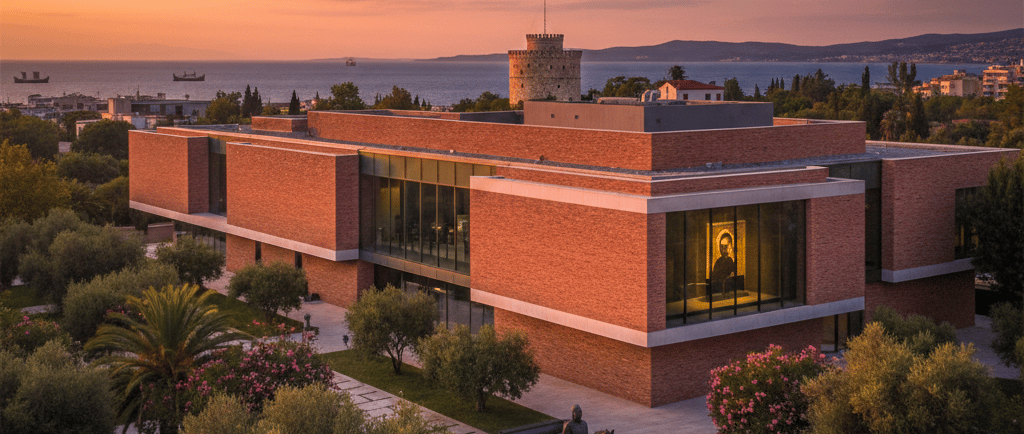
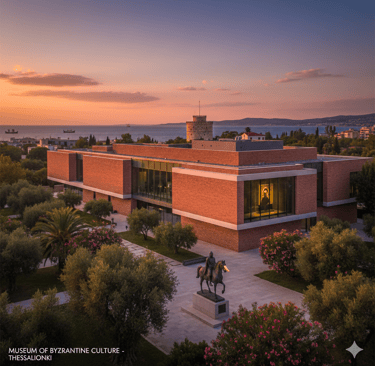
In the sun-drenched city of Thessaloniki, history isn't just buried in the ground; it’s woven into the very fabric of the streets. While the Western world often treats the Middle Ages as a "Dark Age," the Byzantine Empire—the Eastern Roman Empire that outlived Rome by a millennium—was busy inventing forks, engineering "Greek Fire," and turning Thessaloniki into its vibrant "Second Capital."
The Museum of Byzantine Culture in Thessaloniki is the treasure chest for these stories. It isn't a dusty hall of statues; it’s a narrative of an empire that was as sophisticated as it was scandalous.
1. The Saint, the Spear, and the Sea
Thessaloniki’s identity is inseparable from its patron, Saint Demetrius. According to local lore, the city didn't just survive the massive Slavic and Avar sieges of the 6th and 7th centuries through walls alone.
Legend says that during a particularly bleak assault, the Saint himself was seen walking atop the city walls, dressed as a Roman foot soldier. He supposedly struck the first barbarian to reach the ramparts with his spear, sending a domino effect of falling enemies back down the ladders. In another tale, he was seen walking across the waves of the Thermaic Gulf, causing the enemy fleet to collide in a chaotic, watery wreck.
Look for in the Museum: Small lead and glass bottles called koutrouvia. Pilgrims used these to collect "miraculous myrrh" that supposedly flowed from the Saint’s tomb—medieval holy souvenirs!
2. The Emperor with the Golden Nose
Byzantine politics was a "game of thrones" where losing often meant mutilation rather than death. Because an Emperor was required to be physically "perfect," rivals were often blinded or had their noses slit (rhinotmetos) to disqualify them from the throne.
The most famous "victim" was Justinian II. After being overthrown in 695 AD, his nose was hacked off and he was sent into exile. Most people would have retired quietly, but Justinian II had a prosthetic nose made—allegedly out of solid gold—and eventually raised a barbarian army to retake Constantinople. He ruled for another six years, proving that you didn't need a nose to wear a crown.
3. The Great Chariot Riot of 390 AD
If you think modern sports fans are intense, they have nothing on the Byzantines. In 390 AD, Thessaloniki was the site of a horrific massacre sparked by a chariot race.
A popular charioteer was arrested for an "outrageous" crime (likely a romantic scandal), and the fans—members of the "Blue" and "Green" factions—rioted, killing a local general. The Emperor Theodosius I was so enraged that he invited the citizens to the Hippodrome for a "special race," then locked the gates and ordered his soldiers to slaughter everyone inside. Nearly 7,000 people died over a sports riot.
4. Inventions: From Forks to Flamethrowers
The Museum reveals a daily life that was surprisingly modern. The Byzantines were the first to introduce the table fork to Europe; before then, Westerners were largely using their hands or knives. When a Byzantine princess brought her forks to Venice for her wedding, the locals were scandalized by her "decadence."
They also guarded the secret of Greek Fire, a mysterious liquid (likely petroleum-based) that could burn on water. It was the medieval version of a napalm flamethrower and was the primary reason the empire's wooden ships remained undefeated for centuries.
5. The Museum’s "Secret" Rooms
Walking through the Museum of Byzantine Culture is like traveling through time.
The "Elysian Fields" Gallery: This room showcases funerary wall paintings that transition from pagan imagery to Christian paradise. It’s one of the richest collections of its kind in the world.
The "Dori Papastratou" Collection: Look for the religious engravings. These weren't just art; they were the "social media" of the time, distributed to the faithful to spread news of miracles and motivate pilgrimages.
+1
The Castles Gallery: This section uses video and artifacts to show how life functioned inside a Byzantine fortress—from the high-stakes warfare to the surprisingly delicate jewelry worn by the women living behind the battlements.
Why it matters today
Thessaloniki remains the most "Byzantine" city in Greece. The museum doesn't just show you what was; it shows you why the city feels the way it does—the blend of the mystical, the imperial, and the resilient.
Here is a curated Byzantine Walk that connects the museum’s stories to the physical stones of the city:
Stop 1: The Rotunda (The Imperial Core)
Start here to understand the scale of Roman-to-Byzantine transition. Built by Emperor Galerius around 306 AD, this massive circular structure was intended to be a mausoleum but became a church.
The Connection: Look at the mosaics in the dome. They depict "Mansion-like" structures of Paradise.
In the Museum: You’ll find fragments of similar wall paintings and marble revetments that show how these cold stone buildings were once exploding with color and gold.
Stop 2: The Arch of Galerius (Kamara)
Just a few steps from the Rotunda, this arch celebrates a victory over the Persians.
The Story: Notice the intricate carvings of soldiers and elephants. This represents the "Old Rome" power that the Byzantine Empire inherited and eventually transformed into a Christian-Greek identity.
Stop 3: Church of Acheiropoietos
This is one of the few 5th-century basilicas that has remained remarkably intact. Its name means "Made Without Hands," referring to a miraculous icon of the Virgin Mary.
The Connection: The museum houses many Middle Byzantine icons. Seeing them in a museum is one thing; standing in a 1,500-year-old nave where they were originally venerated provides the true "Byzantine atmosphere."
Stop 4: The Church of Saint Demetrius (Hagios Demetrios)
This is the heart of the city’s folklore. Remember the story of the "Miraculous Myrrh"? This is where it happened.
The Crypt: Go downstairs to the underground crypt. This was the Roman bath where Saint Demetrius was imprisoned and martyred.
In the Museum: The museum displays the "Reliquary of St. Demetrius," a small, ornate box used to hold the Saint's remains. Seeing the crypt first makes the reliquary much more poignant.
Stop 5: The Byzantine Walls (Ano Poli)
Walk (or take a taxi) up to the Trigoniou Tower in the Upper Town. These walls protected the city from the sieges where St. Demetrius supposedly appeared.
The View: From here, you can see the entire Thermaic Gulf. You are standing on the very ramparts where soldiers used "Greek Fire" to defend the "Second City" of the Empire.
Stop 6: The Museum of Byzantine Culture
End your walk back at the museum (near the White Tower). After walking the city, the artefacts will no longer feel like "items"—they will feel like the personal belongings of the people who lived in the houses and prayed in the churches you just visited.